OER are teaching, learning, and research materials that you may use and reuse freely and without needing to seek permission. OERs are available in any medium – digital or otherwise. They reside in the public domain or have been released under an open license that permits no-cost access, use, adaptation, and redistribution by others with no or limited restrictions. Examples of OER include, but are not limited to, online textbooks, course modules, videos, tests, software, and teaching materials.
Equity
OERs provide equitable access to textbooks and other teaching materials. OERs can ensure that all students, regardless of socioeconomic level, can access critical learning materials to complete their course work.
Flexibility
OERs also provide faculty with flexibility, and encourage innovative teaching approaches. Using OERs, faculty can customize their courses beyond the textbook. Faculty are able to download material, personalize it to fit their course, and then share it with their students.
Customization
Faculty is able to mix and match different OERs to help meet the needs of their class. As new information emerges, it is also easy to update and revise OERs.
Resources at the University of Miami
Using OERs in your online courses can ensure your students have free access to relevant materials for learning. Your subject librarian or medical librarian can direct you to more information about OERs in your field. Faculty webpages can also be sources of OER content.
PETAL is a program at the University of Miami that provides many tools for teaching and educational development. Their mission is to develop, nurture, and recognize excellence in teaching while creating, testing, and disseminating innovative educational practices in higher education classrooms that facilitate optimal learning among diverse students who leave UM prepared for a global, technological, multicultural future. PETAL provides a comprehensive suite of programs and initiatives to support faculty in their teaching and learning goals. These include workshops on relevant topics, personalized consultations, mentorship from experienced educators, faculty learning communities for collaborative enhancement of teaching and learning, faculty reading groups for pedagogical literature discussion, a faculty showcase for sharing innovative teaching strategies, orientation programs for new faculty, a speaker series featuring thought leaders in education, and a platform for open discussion and dialogue on various teaching and learning topics, known as UDialogue. PETAL offers a comprehensive set of resources aimed at improving teaching and learning.
Course Reserves include book chpters, syllabi, lecture notes, etc. that are available in electronic format. uReserves lets you easily create, maintain, and evaluate course reserves materials. With uReserves, you can assemble materials of all types - physical books, online or digitized chapters, scholarly articles, videos, etc.
The Open Educational Resources Initiative has a page where OER and related funded opportunities are constantly being shared as they are made available. Check here for opportunities!
Creative Commons License
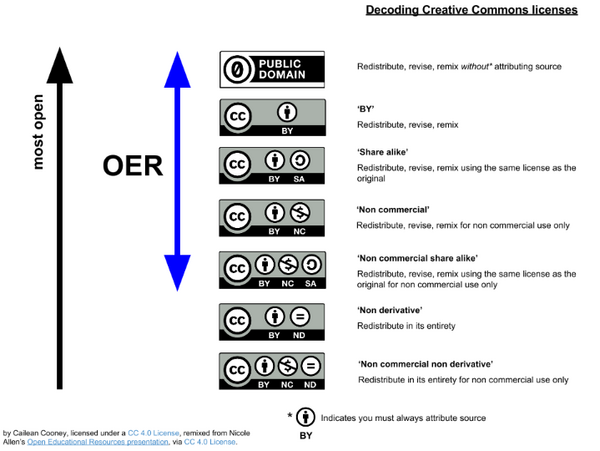
OER material either resides in the public domain or has been released under a Creative Commons license that allows free use and adaptations by others. Creative Commons licenses provide a standardized way to give permission to share and use creative works.
There are six main types of licenses that range from the most restrictive in terms of permissions and reuse to the most open. It is important to understand what is allowed under specific licenses when it comes to searching for content to use or when you are creating your own content and are choosing between licenses.
5 Rs of OER
When choosing an open license for your OER, you want to make sure that the following permissions are allowed:
Retain: Content can be downloaded and saved.
Reuse: Content can be used for your own purpose.
Revise: Content can be adapted, modified, or translated.
Remix: Content can be combined with others to make a new work.
Redistribute: Content can be shared with others in its original or edited form.
You can also use the Chooser tool on the Creative Commons website, which helps you find the right license for your work: Creative Commons Chooser.
OERs and Open Pedagogy can be published in Scholarship@Miami, the institutional research repository and discovery portal for the University of Miami. Scholarship@Miami features selected research and scholarly works prepared by faculty, students, and staff of the university. Items in Scholarship@Miami include published articles, UM theses and dissertations, data sets, conference papers, proceedings, lectures, projects, reports, presentations, and other scholarly work and research output.

 A Librarian